
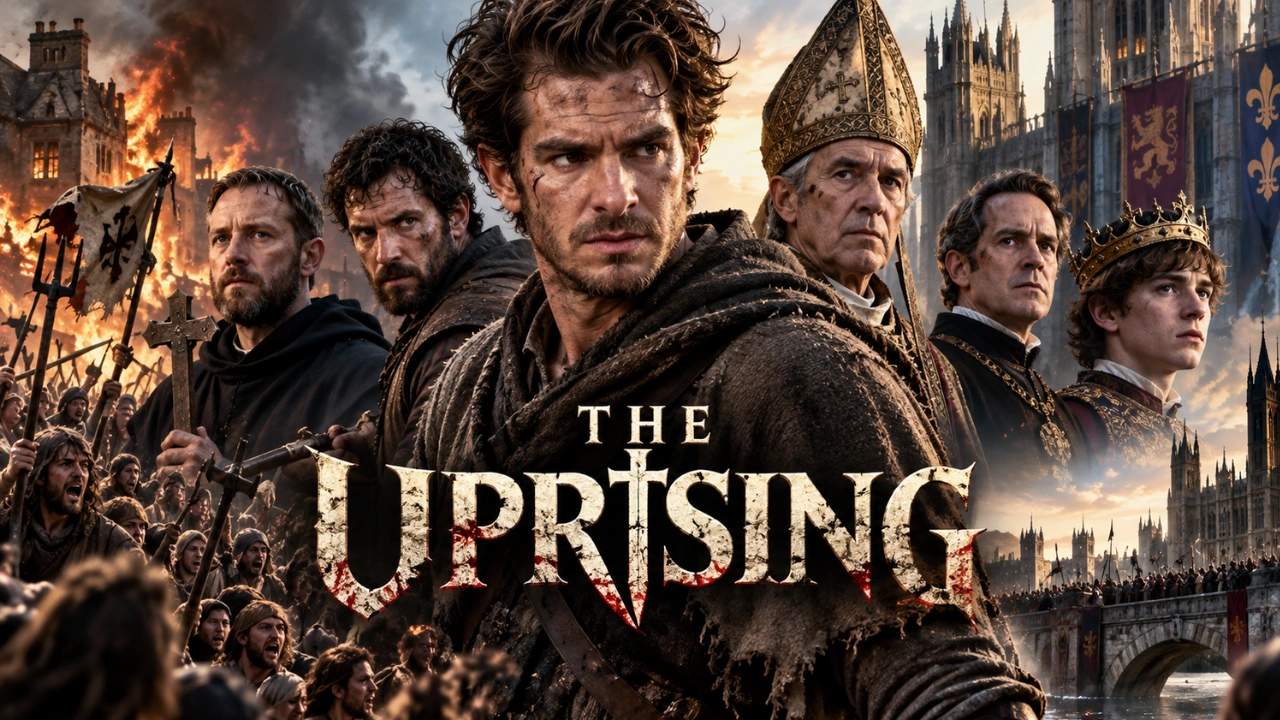
The Uprising Movie: Cast, Story, Release Date & True History
The Uprising is a historical drama from writer-director Paul Greengrass, starring Andrew Garfield as Ploughman, a fictional character caught up in one of medieval England’s most famous rebellions.
Set against the Peasants’ Revolt of 1381, the film combines real historical figures—including Wat Tyler, John Ball and the young King Richard II—with fictional characters and dramatic storytelling. It also explores the cultural connection between the revolt and the Robin Hood legend, although The Uprising is not a traditional Robin Hood movie.
If you’re searching for The Uprising movie cast, story, release date, true history, Robin Hood connection or historical accuracy, here’s what you need to know.
The Uprising Movie: Quick Facts
| Detail | Information |
|---|---|
| Movie | The Uprising |
| Director & Writer | Paul Greengrass |
| Lead Actor | Andrew Garfield |
| Main Character | Ploughman |
| Historical Setting | England, 1381 |
| Based On | Peasants’ Revolt of 1381 |
| Distributor | Focus Features |
| Release | September 2026 |
| Runtime | Approximately 2 hours 8 minutes |
| Rating | R for violence and bloody images |
What Is The Uprising Movie About?
The Uprising takes place in England in 1381, when anger over taxation, labor restrictions and social inequality erupted into a major rebellion.
Andrew Garfield plays Ploughman, a fictional protagonist who becomes involved in the uprising. Through his story, the film brings a personal perspective to a crisis that eventually reached London and directly challenged the authority of King Richard II.
The historical circumstances were complicated. England was still dealing with the consequences of the Black Death, which had dramatically reduced the population and changed the country’s labor system. Workers became more valuable because of the shortage of labor, while authorities attempted to maintain control over wages and working conditions.
Taxation added another layer of resentment.
The government’s need for revenue, particularly during its continuing conflicts, contributed to pressure on ordinary people. The poll tax introduced in 1380 became a major source of anger and helped turn existing dissatisfaction into open resistance.
The result was not simply a dispute over one tax. It was a broader confrontation over money, work, social status and political power.
That makes the Peasants’ Revolt a natural subject for Greengrass, whose films often place audiences inside moments of intense political and social conflict.
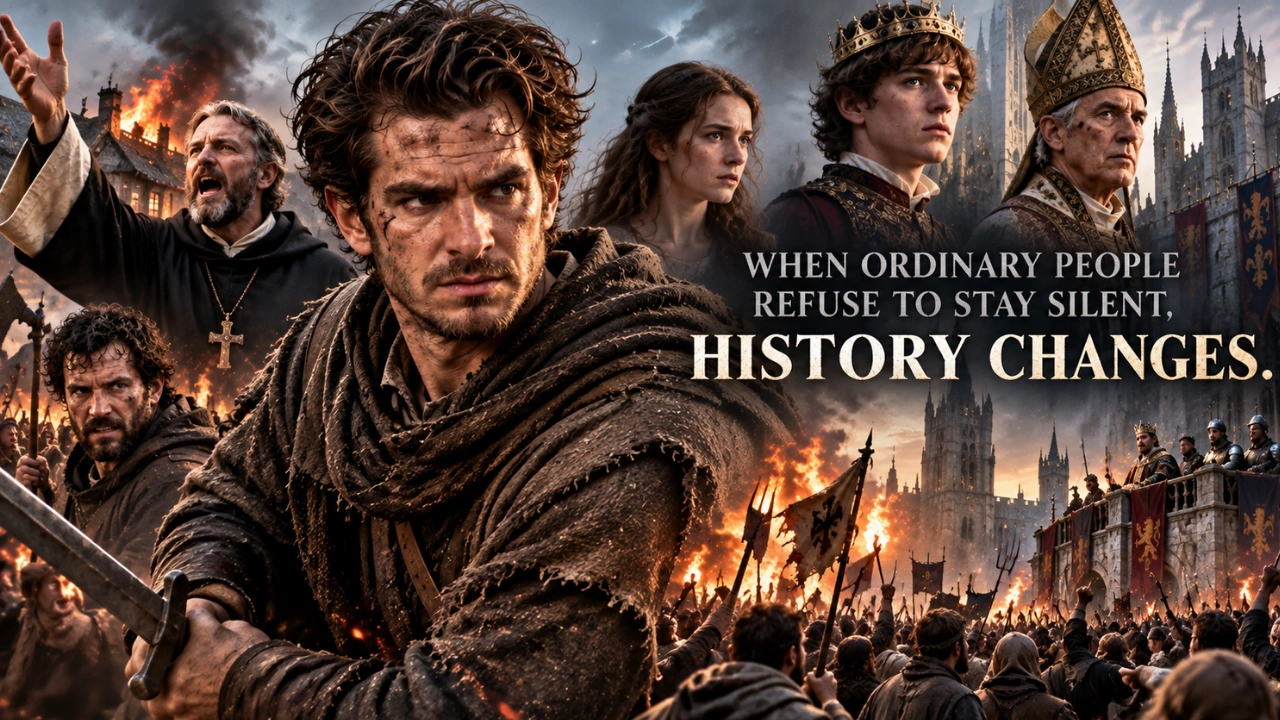
The Uprising Movie Cast
The cast combines fictional characters with people who genuinely existed during the 1381 revolt.
For the full cast and character details, you can also view The Uprising on IMDb.
Andrew Garfield as Ploughman
Andrew Garfield plays Ploughman, the movie’s central fictional character.
Creating a fictional protagonist gives the filmmakers freedom to tell a personal story while moving through real historical events. Rather than following only kings, officials and famous rebel leaders, the audience experiences the upheaval through someone positioned closer to ordinary people.
Garfield’s role also gives the film a recognizable leading actor capable of carrying both the physical and emotional demands of a historical drama.
Jamie Bell as John Ball
Jamie Bell plays John Ball, a real preacher associated with the Peasants’ Revolt.
Ball became known for preaching ideas that challenged aspects of the existing social hierarchy. His involvement adds a religious and ideological dimension to the movie’s depiction of the rebellion.
Cosmo Jarvis as Wat Tyler
Cosmo Jarvis portrays Wat Tyler, one of the best-known leaders of the historical revolt.
Tyler emerged as a major rebel leader as the uprising spread toward London. His inclusion gives The Uprising a direct connection to one of the central figures in accounts of the 1381 rebellion.
Stephen Dillane as Archbishop Sudbury
Stephen Dillane plays Archbishop Sudbury, a powerful church and political figure who became a target during the revolt.
Tom Hollander as Treasurer Hales
Tom Hollander appears as Treasurer Hales, another historical figure associated with the royal administration and one of the officials targeted by the rebels.
Woody Norman as King Richard II
Woody Norman plays King Richard II.
Richard became king in 1377 and was only a teenager when the Peasants’ Revolt began. His age is an important part of the historical story because the rebellion placed a very young monarch at the center of a national political crisis.
Other Cast Members
The supporting cast includes:
- Thomasin McKenzie as Alyce
- Jonny Lee Miller as Mayor Walworth
- Katherine Waterston as the Countess
- Sky Yang as the Scribe
Who Directed The Uprising?
The Uprising was written and directed by Paul Greengrass.
Greengrass is known for films that put viewers close to chaotic and high-pressure situations. His use of movement, handheld camerawork and a documentary-like visual approach has become a recognizable part of his style.
That technique fits a story about a mass rebellion particularly well.
The film’s medieval England is not simply a backdrop for sword fights. Crowds, streets, political tension and the breakdown of authority are central to the experience.
That gives The Uprising a grittier identity than a traditional medieval adventure.

Is The Uprising Based on a True Story?
Yes, but it is not a literal retelling of history.
The movie is inspired by the Peasants’ Revolt of 1381, a real rebellion that spread through parts of England and eventually reached London.
You can also read more about the film on Wikipedia for additional background.
Several people portrayed in the film were real historical figures, including:
- Wat Tyler
- John Ball
- King Richard II
- Simon Sudbury
- Robert Hales
- William Walworth
However, Ploughman is fictional.
This is an important distinction when watching historical movies. Filmmakers often create fictional characters, condense timelines and invent dialogue to turn complicated historical events into a coherent dramatic story.
Therefore, The Uprising should be viewed as a fictionalized historical drama inspired by genuine events, rather than a documentary.
What Happened in the Peasants’ Revolt of 1381?
The Peasants’ Revolt developed from several long-running pressures.
The Black Death had devastated England’s population decades earlier. With fewer workers available, labor became more valuable, but government policies attempted to restrict wage increases and preserve existing social arrangements.
At the same time, England required substantial revenue, and taxation placed increasing pressure on ordinary people.
The poll tax became a particularly explosive issue.
Resistance began in Essex and Kent in 1381 and quickly spread. Rebel groups moved toward London, where the uprising became a direct challenge to the royal government.
The rebels attacked officials and institutions associated with the system they opposed. Records were destroyed, prisons were opened and prominent figures were targeted.
Wat Tyler became a leading figure, while John Ball provided a powerful ideological voice.
The crisis eventually brought the rebels into direct contact with Richard II.
The revolt was ultimately suppressed, and many of the promises made during the crisis were not permanently honored. Wat Tyler was killed during the confrontation at Smithfield, after which the rebellion rapidly lost momentum.
Although the revolt lasted only a short time, its significance was much greater than its duration.
It demonstrated the ability of ordinary people to organize and challenge the political establishment on a remarkable scale.
Is The Uprising a Robin Hood Movie?
Not exactly.
The primary historical subject of The Uprising is the Peasants’ Revolt of 1381, not the traditional Robin Hood story.
The Robin Hood connection comes from the broader cultural idea of ordinary people resisting unjust or corrupt authority. Robin Hood became one of England’s most enduring legendary figures, while the Peasants’ Revolt created its own historical tradition of resistance against powerful institutions.
The two traditions can therefore overlap thematically without being the same story.
That distinction is important because viewers expecting a conventional Robin Hood adventure may be surprised by The Uprising. The film is much more concerned with rebellion, social pressure and political conflict than with the familiar outlaw formula.
In other words, think of The Uprising as a 1381 rebellion drama with a Robin Hood connection, rather than a Robin Hood origin story.

How Historically Accurate Is The Uprising?
The film has a real historical foundation, but not every part of the story should be interpreted as historical fact.
The Peasants’ Revolt itself is genuine, as are several of the major figures represented in the movie. The political and economic pressures behind the uprising are also rooted in documented medieval history.
The fictionalization mainly enters through the film’s characters and storytelling.
Ploughman’s personal journey, for example, exists to connect audiences emotionally with events that involved thousands of people and numerous locations.
The Robin Hood element also requires some caution. Robin Hood belongs primarily to English legend and folklore rather than the documented history of the 1381 revolt.
So if historical accuracy is your priority, The Uprising is best used as an introduction to the period—not as the final word on what happened.
The Uprising Release Date
Focus Features lists September 10, 2026 as the film’s theatrical release date.
An earlier studio announcement gave September 11, 2026 as the domestic release date. Because theatrical schedules can vary by market and may be updated, audiences should check their local cinema listings for the latest showtimes.
The film has an R rating for violence and bloody images and a runtime of approximately 2 hours and 8 minutes.
What Genre Is The Uprising?
The Uprising is primarily a historical drama, with strong action and political elements.
Its story is driven by social conflict rather than fantasy. The violence comes from the collapse of political order and the confrontation between rebels and those defending the existing system.
Greengrass’s filmmaking style reinforces that approach. The movement and intensity of the camera can make the rebellion feel immediate rather than distant, placing viewers among crowds and inside the confusion of the uprising.
For audiences who prefer polished historical romances or fantasy adventures, the style may feel very different. Fans of gritty political and historical dramas are more likely to appreciate the approach.
What Are Critics Saying About The Uprising?
Early critical reaction has been mixed.
Some responses have praised the film’s performances, atmosphere and gritty presentation of medieval England. Andrew Garfield’s central performance has attracted attention, while the supporting cast gives the historical figures considerable presence.
The film’s handling of the Robin Hood connection has been more divisive.
Some criticism has focused on the later part of the movie and its movement away from the grounded historical drama established earlier. That creative decision may work for viewers who enjoy historical films with mythic elements, while others may prefer a stricter interpretation of the documented revolt.
The mixed response makes The Uprising the kind of historical movie that may benefit from viewers knowing what they are getting into before watching.
Should You Watch The Uprising?
If you enjoy historical dramas, medieval history, political conflicts, Andrew Garfield or Paul Greengrass, The Uprising deserves a place on your watchlist.
Looking for more movies to watch? Explore our Movie section for more film reviews, stories and recommendations.
Its biggest advantage is the historical event itself. The Peasants’ Revolt combines taxation, class conflict, religion, political power and a young king facing a serious challenge to royal authority.
The film then uses fictional storytelling to make that complicated history accessible to a modern audience.
Just don’t expect a documentary or a conventional Robin Hood adventure.
The Uprising is best understood as a fictionalized drama built around the real Peasants’ Revolt of 1381. Knowing that distinction makes it easier to appreciate the film on its own terms while recognizing where historical record gives way to cinematic storytelling.
Final Takeaway
The Uprising movie combines real medieval history with fictional characters and modern filmmaking. Its strongest historical foundation is the Peasants’ Revolt of 1381, while its Robin Hood connection adds a layer of legend and interpretation.
For viewers interested in what really happened in 1381, the film can be an engaging starting point—but the historical record remains the better source for separating fact from fiction.
The Uprising Movie FAQ
1. Is The Uprising movie based on a true story?
Yes. The Uprising is inspired by the real Peasants’ Revolt of 1381 in England. The film also uses fictional characters and dramatized events.
2. Is The Uprising a Robin Hood movie?
No. The movie primarily tells a story inspired by the Peasants’ Revolt of 1381. It has a connection to the Robin Hood tradition but is not a conventional Robin Hood adventure.
3. Who plays Ploughman in The Uprising?
Andrew Garfield plays Ploughman, the film’s central fictional character.
4. Who plays Wat Tyler?
Cosmo Jarvis plays Wat Tyler, one of the major leaders associated with the historical Peasants’ Revolt.
5. Who plays John Ball?
Jamie Bell plays John Ball, the preacher associated with the rebel movement.
6. Who plays King Richard II?
Woody Norman portrays King Richard II, the young monarch who confronted the rebels during the uprising.
7. Who directed The Uprising?
Paul Greengrass wrote and directed The Uprising.
8. When was The Uprising released?
Focus Features lists September 10, 2026 as the theatrical release date, while an earlier announcement listed September 11 for the domestic release. Local listings should be checked for current showtimes.
9. How long is The Uprising?
The film runs for approximately 2 hours and 8 minutes and is rated R for violence and bloody images.
10. What historical event inspired The Uprising?
The film is inspired by the Peasants’ Revolt of 1381, a major rebellion against taxation, social restrictions and aspects of England’s political order during the reign of Richard II.