 by
by Introduction
Visions of Blood grabbed me from the very first shot—a dimly lit hallway, creaking floorboards, and the distant echo of breathing. I’m 25 years old, and I’ve been through my fair share of supernatural thrillers… but this one shook me in a way I didn’t expect. Picture me, alone in my apartment at midnight, popcorn in hand, suddenly gripping the seat in anticipation of every shadow. That’s the impact this movie has.
This isn’t just another haunted‑house flick. The premise is deceptively simple—Grace, our lead, steps into a centuries‑old manor for the very first time. She discovers a small, locked wooden box. An inexplicable pull. Candlelight dances around her room. But soon, those shadows start to move. The floorboards whisper. Walls close in. What begins as curiosity soon becomes dread. These Visions of Blood aren’t just visual shocks—they linger, tap at your subconscious, and force you to question what’s real.
In this post, I’m diving deep: character study, atmosphere breakdown, symbolism, comparisons to similar films, and why this movie deserves a spot on your watchlist. Expect spoilers-light, but with enough detail to help you relive the unease I felt. Let’s explore how Visions of Blood toys with perception and stomps on your comfort zone.
What Visions of Blood Is All About
Visions of Blood is a supernatural suspense thriller that follows Grace, a quietly intense protagonist, as she spends her first night in the ancestral home she inherited from a distant relative. The plot kicks off naturally: she arrives, settles in, and during that eerie silence, discovers a small locked box—unremarkable at first, but inexplicably magnetic. As the night wears on, subtle supernatural occurrences begin—candles flicker, voices murmur, and fleeting images of violence and blood surface in reflective surfaces.
Director Alex Marlow, known for his minimalist style, leans heavily into atmosphere rather than dialogue-heavy scenes. The dialogue is sparse, mostly Grace muttering to herself—or whispering to the box. This silence only enriches the unease, drawing viewers into the same isolation Grace experiences. Without giving too much away: yes, Grace unlocks the box eventually—but at what cost?
The beauty of Visions of Blood lies in tension escalation. Early disturbances are small—a whisper in the corridor, a pool of crimson that vanishes when approached. But soon, boundaries collapse. Reality bends. Grace questions her own memories. And you begin to too.
The tagline? Quiet, unsettling, smart horror that wrestles with mental states and historical trauma. The title works double duty—it’s visually explicit (you see blood) and emotionally charged (you feel it). Enough chatter—let’s get into what makes each piece work so damn well.
Detailed Plot Breakdown
Opening Setup
The film begins with Grace arriving at dusk, lugging a suitcase through overgrown hedges. The manor looms in golden-but-decaying grandeur. We’re shown framed photographs—some intact, others drenched in dark stains. Grace glances at them with curiosity, but the camera lingers. It’s as though the house itself is observing her.
Over a muted soundtrack, Grace finds the locked box—ornate yet plain, hidden under bed slats. There’s no backstory given; we’re thrown in as if we inherited this thing along with the property. That deliberate withholding sets you on edge.
First Vision at Midnight
At midnight, Grace lights a single candle. It’s quiet. Too quiet. The candle sputters, the flame quivers. Suddenly, the camera switches to her POV—around a corner, a blur of crimson. No sound. Pulse quickens. She gasps. Candle topples. The shot goes black. Then we hear her stumbling, whispering, “What was that?”
That’s the first real moment of Visions of Blood—you feel the visceral thump in your chest. It’s a smart shock—no gore, no build-up, just pure, immediate dread.
Discovering the Locked Box
Grace returns to the box and tries the latch. It won’t budge. She glances at it knowingly, like it’s taunting her. She circles it. Mutters to herself. The next shot: a finger of blood seeps through a crack in the lid. She recoils. But when she touches it… it’s cold, real.
Then come the hallucinations. A kitchen knife levitating. A bathtub filling with water that turns crimson as she approaches. A dinner table set, but when she reaches for the fork—worms. It all feels connected, building like dominoes. And all tied back to the Visions of Blood motif—blood as memory, gore as message.
Escalation: Reality vs Hallucination
The midsection becomes a chess match. Grace hears voices—her own, her mother’s, children crying, laughter. The visual depiction is masterful—reflections in mirrors jump, shadows detach from walls, and Grace pursues them, only to find emptiness.
One haunting shot: Grace confronts a mirror and ghost‑like figures appear behind her. She turns—nothing. Camera shakes. When she returns her gaze, blood splatter on the mirror. She spins again. It’s gone. Heart pounding.
The Climactic Chapter
By Act Three, the box is open. Inside: a blood‑soaked letter sealed tight with wax. It’s addressed to Grace—and reveals a generational curse. She reads aloud. A final vision: her reflection smiles back with bloody teeth, stepping out of the mirror. She screams, plunges her arm into the mirror’s surface—and awakens on the floor at dawn. Box by her side. Candleglow dying. Her eyes… changed.
Cut to credits. No resolved ending, no neat tie‑offs. Instead—you’re left sleepless, haunted, replaying scenes in your head. And that’s the brilliance of Visions of Blood.
Grace’s Character Study
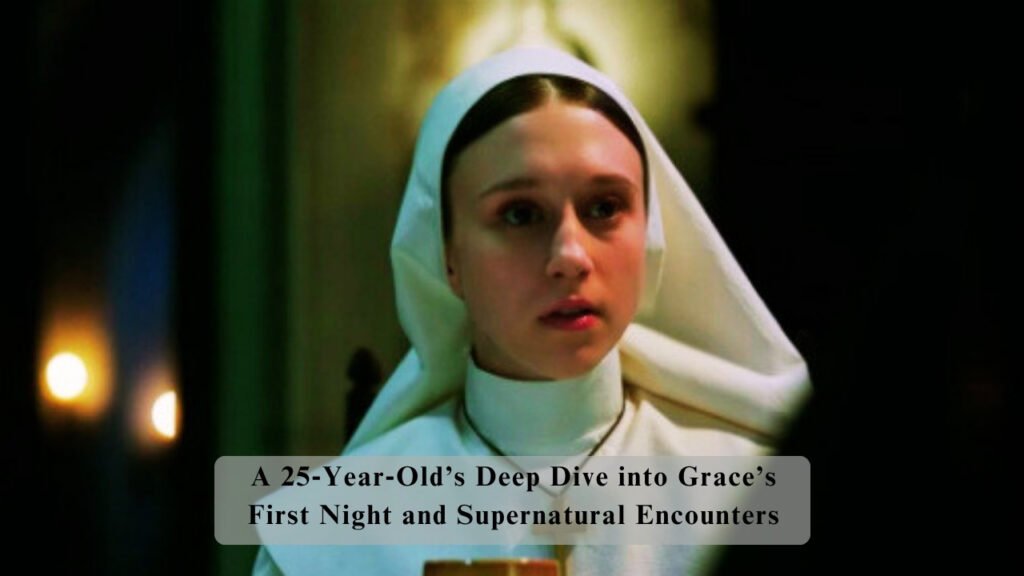
Grace is the heart of the film—and her portrayal is everything. She’s young, but siphoned by stress and grief. In earlier scenes, she paces, writes in a journal, and talks to herself. It feels intimate. She’s paranoid—but so are we. We’re right there with her.
Key to her character is vulnerability. She’s not a horror‑savvy survivor; she’s that friend who says, “I don’t know why I’m here.” That’s relatable. When she sets up the candle and whispers to the box, “I don’t want to be scared,” you feel it.
Her arc is subtle. Visually, she shifts—from daytime pale and uncertain to night-darkened and determined. Her voice lowers. She’s more tentative—every step measured. But by the climax, you see a shift toward desperation. She has to understand what’s in the box. Even if that understanding breaks her.
Her final act—smashing the mirror, piercing it with her hand—is visceral. It’s not brute force, it’s visceral defiance. She’s cracking the curse, or cracking under it. And when dawn comes, that blank stare—could be relief. Could be emptiness. The ambiguity keeps her—and the movie—trapped in your mind long after.
Using Visions of Blood as a measure, Grace carries the emotional tariff of every gory scene and hush‑whisper. She’s more than a victim—she’s a vessel for unseen horrors.
Atmosphere, Direction & Cinematography
The cinematography in Visions of Blood is a masterclass in tension-building. Pale greens and muted grays dominate. Shadows stretch long. The corners of the frame often drift into darkness. Wide shots show empty rooms. Close-ups show trembling hands, flickering flames. Every shot feels intentionally composed.
Director Alex Marlow uses steady movement—slow dolly-ins that creep. A focus pull from Grace’s face to something behind her. Occasionally, handheld jitter enters the frame—always when something shifts in perception. This device makes you feel off-balance with her.
Light plays a major role. Natural daylight is clean, safe, while artificial candlelight is unreliable. Watch how each time the flame flickers, everything freezes for a moment—an unspoken invitation to look closely. The creaky wooden floors groan underneath, creating unease.
Take this shot: Grace descends the main staircase at dusk. Camera behind her. Steps echo. A flash. The candle she holds reflects in the railing—drenched in crimson for a moment, before returning to wax-white. It’s a small instance Visions of Blood uses repetition to keep you unsettled.
Two camera tricks stood out:
Mirror POVs, where the audience sees the reflection first, then turns with Grace—what we see or think we see sometimes overlaps.
Blink-angled frames, where the camera tilts slightly downward or upward mid‑scene—creating a subconscious feeling of unease.
Visually, the locked box sits center-frame sometimes, like it’s part of the set—looming in its own right. That’s smart. It’s part of Grace’s world, just like the fireplace chinatree figurine or dusty portrait.
Overall, the visuals underscore that Visions of Blood is more about creeping dread than jump-scare theatrics.
Sound Design & Music
Sound in Visions of Blood gently vibrates under the visuals. Designer Claire Nguyen layers soft low-end hums, manipulated floor creaks, and distant whispers that seem to shift direction. Dialogue is often drowned by ambient noise until you lean in. In that sense, it demands attention.
The score is minimal—just a simple, looping piano phrase—and when the supernatural hits, silence snaps. A creak. A whisper. A breath. Those moments feel loud because everything else recedes.
Remember that midnight scene? Only sound: Grace’s exhale. Then—drip. Thud. Calm. The viewer expects a rising orchestral note. Instead: nothing. That absence creates the tension.
When the final vision hits, you hear muffled, dissonant strings—bare traces of panic. That’s the power of restraint: the soundscape serves the Visions of Blood aesthetic—quiet, breathless, and tension-first.
Visual Effects & Practical Horror
This isn’t CGI-heavy. It doesn’t need to be. Visions of Blood uses practical effects to ground the horror. A red stain under a door. A handprint from inside a wall. A mirror cracking with tentacle light.
The iconic bathtub scene—the water pouring crimson before collapsing when Grace moves—is done with stage blood and clever cinematography. It burns in your memory because it feels tangible.
Blood doesn’t soak the screen continuously. It’s just enough. Enough to shock. Enough to linger. Enough to thread the psychological horror. A rusted nail dragging across a tabletop. A smear of deep red in a clean room. These small gore notes are more potent than nonstop splatter.
That’s smart restraint. The filmmakers understood that Visions of Blood is about dripping dread, not dripping gore.
Themes & Symbolism
Trauma and Memory
The locked box is an obvious metaphor. We lock away pain. We never look inside. Then one day… we do. Grace is literally (and figuratively) unlocking her inherited trauma. The letter? A family confession, a curse, a secret of spilled blood in generations gone by.
Light vs Dark
Candles represent Grace’s fragile hope. Each flutter is a potential extinguish. Every spark’s demise pushes the story deeper into night. The flicker becomes character in its own right.
Reality vs Illusion
Mirrors aren’t just props—they’re portals. Red liquid in mirrors, voices that echo, reflections that mimic then act independently. Are these real ghosts, or are they living memories? The ambiguity is the point.
Generational Sins
The letter reveals something: sometimes sins of the grandfather bleed through. Grace didn’t do anything wrong. But she pays anyway. How’s that for societal commentary?
Isolation and Loneliness
Grace is alone—no phone reception, no friendly neighborhood guide. That isolation magnifies every creak. It amplifies the Visions of Blood into an internal echo chamber.
Comparison with Other Films
The Babadook
Both explore grief and mental strain inside houses full of shadows. The Babadook uses childlike horror. Visions of Blood feels more adult, more somber.
Hereditary
Family curse, inherited mental deterioration, a crescendo of bizarre occurrences. Visions of Blood mirrors Hereditary in tone, but keeps it smaller, less violent, more psychological.
The Others
Candlelit tone, echoes of old tragedies, performances that keep you guessing. Visions of Blood shares that ghost-house restraint, but adds a visceral edge—especially the blood.
Lake Mungo
Mock found-footage tone. Psychological storytelling. Realism. Visions of Blood isn’t trying to feel ‘documentary real’, but it uses non‑linear editing and POV shots similarly—to unnerve you.
If you like those films, you’ll love this. But Visions of Blood stands out—especially with its locked-box motif and mirrored letter reveal. And the question: are you looking outward at ghosts, or inward at your own memory?
Personal Take & Viewing Tips
Alright, now for the part you came for: how I experienced this movie. At 25, I’ve got a taste for both slow burns and jump-scare rides. Visions of Blood gave me the slow-burn vibes, but with the jolt of red-on-white shock.
I watched it alone, at 12:30 AM, headphones in—just me and the shadows of my ceiling fan. After the first vision, I literally paused the movie to catch my breath. After the bathtub scene, I rewound it to make sure it really happened.
Tips for watching:
- Watch late at night or early morning—when your brain is dreamy. Daylight dilutes tension.
- Use headphones or good speakers—the sound design is half the scare.
- Dim the lights—or black out the room. Candles on screen look brighter.
- Avoid logic traps—this isn’t Saw and it isn’t puzzle‑driven. It’s mood-driven.
- Stay for the credits—soundtrack continues and may reveal extra audio layer.
After it ended, I lay still in the dark. I kept replaying mirror shots in my head. My apartment felt… less empty. If that doesn’t tell you this movie worked, I don’t know what will.
Conclusion & Final Thoughts
So, wrap-up time: Visions of Blood is a haunting whisper in a world overrun by loud scares. It’s the kind of horror that burrows beneath your skin and floats in your vision long after you walk out the theater—or click stop in your living room.
Grace’s journey is your journey—someone entering the unknown, unlocking dark inheritance, and searching for meaning in whispers and reflections. The locked box, haunted mirrors, and crimson stains are not just effects—they’re narrative anchors. The ambiguous ending? Perfect. You’re not left with answers—you’re left with feelings.
If you love atmospheric horror, smart symbolism, and stories that make you feel weird in your own home, give Visions of Blood a haunted evening. Watch it alone, in the dark, and let your imagination fill the spaces. And yeah, maybe double-check your closet when it’s over.
Let me know—did the box truly open? Is Grace free at dawn, or was the curse stitched deeper? Drop your theories in the comments, share with your fellow horror nerds, and dig into my other deep dives—like why “haunted objects” horror never dies.
Catch you next time—and stay spooky.
if you interested this blog related another blog click here…