 by
by Before watching this film, I had already formed a mental expectation based on its trailer. It gave the impression of a visually elegant but emotionally predictable drama — something that would explore class division through scandal and attraction inside a wealthy household.
But once I actually sat through it, I realized that the experience of watching it is far less about events and far more about emotional discomfort. In my opinion, The Housemaid psychological review cannot be limited to discussing story progression because the film doesn’t really function through dramatic twists — it functions through silence, observation, and the slow normalization of morally questionable behavior.
There were moments while watching when I became more aware of my own reaction than what was happening on screen.
That’s a strange thing to say about a film, but here it felt accurate.
The Expectation I Built After Watching the Trailer
After watching the trailer of The Housemaid, I had already created a mental framework of what kind of film this would be. I assumed it would rely on sensual tension, slow manipulation, and eventually a dramatic moral collapse inside a rich household.
So while starting the movie, I wasn’t really expecting to feel mentally uncomfortable — I was expecting to feel narratively engaged.
But the film doesn’t engage you in a traditional dramatic way. Instead, The Housemaid psychological review becomes more about how you react to emotional passivity than how you react to conflict. The situations don’t explode into arguments. They quietly settle into acceptance, and that acceptance becomes the disturbing part.
Calm Behavior That Feels Emotionally Wrong
There are multiple scenes where nothing visibly shocking happens — and yet something feels completely off. Interactions that should ideally create resistance are handled with politeness, silence, or avoidance.
While watching one of the family’s dinner interactions, I remember thinking:
Why does everyone seem comfortable with something that clearly shouldn’t feel normal?
That calmness created more emotional tension for me than any loud confrontation would have. And that’s where The Housemaid psychological review starts to feel like an internal experience rather than an external one.
You are not reacting to action.
You are reacting to emotional inaction.
A Male Character Who Is Hard to Emotionally Decode
The male authority figure in the house is not portrayed in a typically threatening manner. He doesn’t raise his voice. He doesn’t dominate conversations. In fact, his composure makes him appear emotionally neutral in many situations.
And honestly, that made things worse.
Because while watching, I kept questioning whether I was overinterpreting his behavior or whether the film was deliberately presenting him in a morally ambiguous way. If this character had been openly manipulative from the start, it would have been easier to process the emotional betrayal that follows.
But the film denies that clarity — and this denial becomes central to The Housemaid psychological review as a viewer-based experience.
Emotional Isolation Inside a Physically Luxurious Space
The housemaid is physically present in almost every major development within the house, yet she rarely becomes emotionally included in conversations that define her own situation.
People speak about her decisions without involving her.
They react to her presence without acknowledging her emotional state.
That narrative distance made me realize that her vulnerability is not just personal — it’s structural. The environment itself doesn’t allow emotional participation from someone in her position.
If she had been given more conversational agency in even one or two key scenes, I think the emotional interpretation of the film would shift dramatically.
And this is why The Housemaid psychological review feels more layered than expected.
Watching the Film Felt Like Observing Social Behavior
There were moments when the film didn’t feel like a drama at all. It felt more like an observation of how social hierarchy quietly enforces itself without needing open aggression.
No one needs to shout.
No one needs to threaten.
The power dynamic becomes clear through small gestures, controlled tone, and silent acceptance.
At one point, I realized that I was less focused on what would happen next and more focused on how calmly everyone was behaving in morally complex situations. That emotional restraint made the viewing experience feel almost clinical — like watching a behavioral pattern unfold.
This subtlety is exactly what strengthens The Housemaid psychological review from an analytical viewer’s perspective.
The Influence of an Overlooked Character
I also kept wondering how the film’s emotional impact would change if the older female authority figure wasn’t present within the household dynamic.
Her presence doesn’t always create visible tension, but it reinforces a kind of silent enforcement within the house. Without her, the unfolding situation might feel like a personal betrayal between individuals.
But with her involvement, it starts to feel institutional.
Almost as if the environment itself is structured to protect hierarchy rather than fairness.
This added layer of enforcement significantly shapes The Housemaid psychological review beyond a simple interpersonal conflict.
The Ending Leaves Emotional Questions Unresolved
By the time the film ends, I didn’t feel closure in a traditional narrative sense. I didn’t feel like justice had been served or even denied.
I just felt aware.
Aware of how easily politeness can mask imbalance.
Aware of how silence can replace confrontation.
Aware of how environments can normalize discomfort if no one actively questions it.
That lingering emotional ambiguity stayed with me longer than any dramatic reveal could have.
And in my opinion, that’s what makes The Housemaid psychological review feel less like a summary exercise and more like a reflection on how viewers process quiet authority and invisible pressure within domestic spaces.
The Film Doesn’t Ask You to Like Anyone
One thing I personally noticed while watching The Housemaid is that the film never really pushes you to emotionally attach yourself to any particular character.
Normally, even morally grey films give you at least one emotional anchor — someone whose perspective you can follow without hesitation. But here, every character feels distant in some way. That emotional distance creates a strange viewing experience where you’re not rooting for anyone… you’re just observing how each person justifies their own behavior.
Because of this, The Housemaid psychological review starts to feel less like watching a character journey and more like watching social roles interact with each other. You’re not invested in outcomes as much as you’re invested in understanding how situations are being silently accepted.
Visual Luxury vs Emotional Suffocation
There’s also an interesting contradiction between how luxurious the environment looks and how emotionally suffocating it feels.
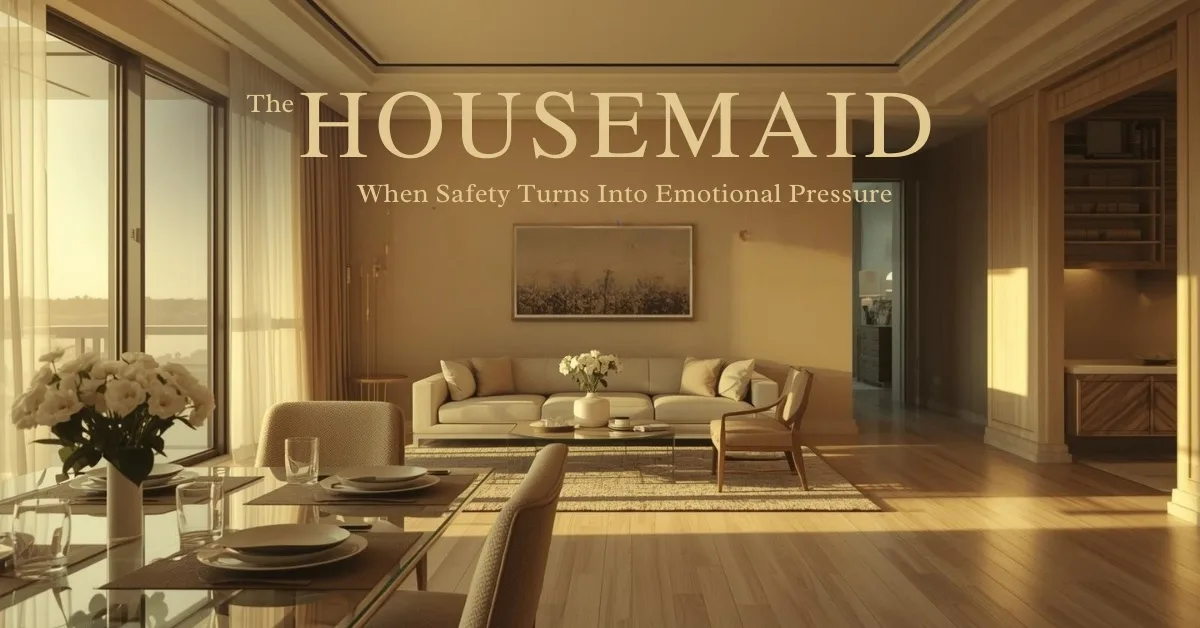
The house itself is beautifully maintained, aesthetically pleasing, and visually calm. But despite that comfort, there’s an emotional coldness in how people interact within that space. The setting doesn’t provide warmth — it amplifies hierarchy.
While watching, I remember thinking that if this exact situation had taken place in a modest or chaotic environment, the emotional interpretation might have been different. But here, the elegance of the space makes the imbalance feel more intentional.
This contrast adds another dimension to The Housemaid psychological review, where physical comfort becomes a backdrop for emotional discomfort.
It Changes How You Interpret Politeness
After a certain point, I began to notice how politeness itself functions as a kind of emotional barrier in the film.
Nobody openly resists anything.
Nobody openly agrees either.
Everything happens within a controlled tone — and that control becomes a tool of power. Conversations that appear respectful on the surface often carry implications that are never spoken directly.
Watching this made me rethink how politeness can sometimes be used to avoid accountability rather than maintain harmony. And that subtle psychological observation becomes a major takeaway from The Housemaid psychological review as a viewer.
If you enjoy reading this The Housemaid, you can explore more film analysis on our website.
Final Thought as a Viewer
This isn’t a film that tries to shock you with sudden twists or intense confrontations.
Instead, it quietly unsettles your moral expectations and then allows that discomfort to grow without offering resolution. If you go into it expecting a dramatic payoff, you might feel emotionally confused.
But if you watch it with an analytical mindset, The Housemaid psychological review becomes an unexpectedly introspective experience that reveals more about social dynamics than about individual decisions.
And honestly, I didn’t expect a film set almost entirely inside one house to feel this psychologically intrusive even after it ended.