 by
by As a 25-year-old boy who grew up watching sci-fi movies, I never thought a film could shake me to the core the way Dune did. I’m not just talking about the breathtaking visuals or the haunting soundtrack—though those are legendary—but the story itself. The deeper I got into the movie, especially its sequel, the more I realized this wasn’t just another futuristic battle saga. It was a powerful reflection on leadership, sacrifice, and the price of destiny.
So here’s my take on Legacy of Dune—is it truly the beginning of a new empire, or have we just witnessed the end of freedom?
What is Legacy of Dune Really About?
Let’s unpack this. At the heart of Legacy of Dune lies the story of Paul Atreides. A young noble thrust into a violent, political storm not of his making, he emerges as a messiah figure among the Fremen, a desert-dwelling people fighting for survival. But Paul’s transformation from a hunted heir to the Emperor of the known universe raises more questions than it answers.
Is Paul a liberator or a conqueror? Is his victory a triumph of destiny or the beginning of tyranny? This is the essence of Legacy of Dune—a complex web of prophecy, power, and purpose.
Paul Atreides: Savior or Tyrant?
Paul is one of the most layered characters in science fiction cinema. On the surface, he is a hero. He avenges his family, unites the oppressed, and defeats the corrupt Emperor. But a closer look reveals a darker undertone. His rise is driven by prophecy, a myth planted by the Bene Gesserit to manipulate entire civilizations.
He knows he’s being used. Yet he allows the myth to flourish, using it to fuel his campaign. That’s when I started asking myself: Is Paul still the same noble young man from the House Atreides—or has he become the very tyrant he sought to destroy?
This duality is what makes Legacy of Dune so haunting. Power comes at a cost, and Paul pays for it with his humanity.
The Price of Victory: Was It Worth It?
From a cinematic perspective, Paul’s victory is epic. The visuals of the final battle, the alliance with the Fremen, and the downfall of the Emperor—these scenes are unforgettable. But strip away the glory, and you’re left with something far more tragic.
The price of Paul’s victory is freedom—both his own and the galaxy’s. By embracing the myth, Paul sets off a galactic jihad that he cannot control. Millions will die in his name, not because he wants them to, but because he let a lie become truth.
That’s the cost of Legacy of Dune. It’s not just about winning the throne. It’s about losing the soul.
Why Legacy of Dune Matters More Than Ever
In today’s world, Legacy of Dune feels more relevant than ever. We live in an era where truth is often manipulated, where powerful figures rise by fueling belief rather than fact. Watching Paul’s journey feels eerily familiar.
He starts as a victim of a corrupt system but ends up creating a new one—just as brutal, if not worse. And the saddest part? He knows it. He’s aware that the prophecy is false. But he also knows that denying it would destroy everything he’s built.
It’s a chilling reminder that even the best intentions can lead to oppression. In this way, Dune’s Legacy serves as a warning: the line between savior and tyrant is dangerously thin.
A Sci-Fi Masterpiece With Real-World Implications
Legacy of Dune isn’t just for sci-fi fans. It’s a mirror held up to society. We see echoes of Paul’s journey in politics, religion, and media. Leaders who rise on waves of belief, only to become trapped by the very systems they created.
As a 25-year-old boy passionate about storytelling, I believe Dune is more than entertainment—it’s education. It teaches us to question power, to look beyond the surface, and to be wary of heroes who are too perfect.
The movie doesn’t offer easy answers. Instead, it challenges us to think deeply about our own legacy. What kind of world are we building? And at what cost?
The Empire Paul Built: Freedom Lost?
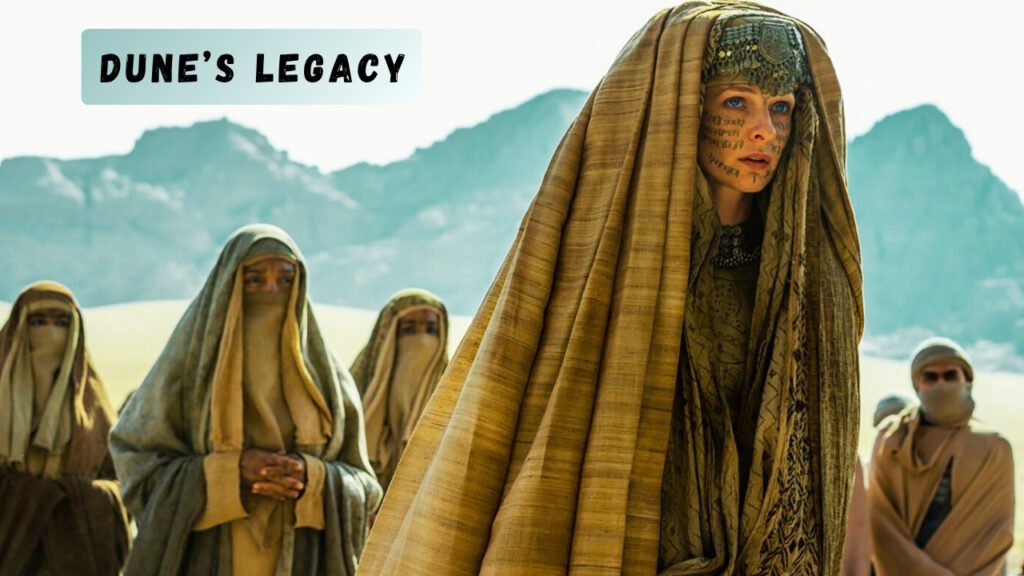
Let’s look at the empire Paul creates. On paper, it looks like a success. He ends the reign of a corrupt Emperor, brings stability to a fractured galaxy, and gives the Fremen a powerful voice.
But beneath the surface, the foundation is shaky. His rule is built on fear, prophecy, and bloodshed. Freedom becomes a luxury, not a right. Those who question him are labeled heretics.
In trying to save the galaxy, Paul unintentionally enslaves it. This is the heartbreaking truth of Legacy of Dune—that sometimes, salvation demands more than we can give. And in giving too much, we lose everything.
Dune’s Cinematic Brilliance: Visuals That Speak Volumes
I can’t talk about Legacy of Dune without praising the cinematic brilliance behind it. Denis Villeneuve’s direction is nothing short of masterful. The sweeping shots of Arrakis, the tension-filled score, and the meticulously crafted costumes all serve one purpose: to immerse us in a world where every detail matters.
But what impressed me the most was how the visuals supported the theme. The harshness of the desert mirrors the harshness of Paul’s choices. The darkness creeping into his eyes reflects the moral grayness of his rule.
This isn’t just world-building—it’s emotional storytelling. And it makes Dune’s Legacy one of the most profound visual experiences of our time.
Why Fans Are Divided: The Controversy Around Paul’s Legacy
Not everyone agrees on what Legacy of Dune really means. Some fans see Paul as a misunderstood hero, doing what he must in an unforgiving universe. Others view him as a cautionary tale—a man who lost his way by embracing a myth.
As a blogger and lifelong fan, I believe both views are valid. That’s the beauty of Dune’s Legacy. It refuses to spoon-feed us answers. Instead, it presents a morally complex world and asks us to find our own truth.
This has sparked countless debates online. Is Paul a savior or a tyrant? Is his empire a new beginning or a betrayal of freedom? These questions make the movie unforgettable—and deeply personal.
Final Verdict: The Beginning of a New Empire or the End of Freedom?
So where do I stand?
As a 25-year-old boy who loves science fiction, I want to believe that Paul’s legacy will lead to something better. That the sacrifice was worth it. That somewhere in the ashes of war, a better future is rising.
But the realist in me knows that empires built on prophecy rarely end well. Freedom sacrificed in the name of order is hard to reclaim. And myths, once believed, are almost impossible to undo.
Legacy of Dune is both a triumph and a tragedy. It’s the story of a man who changed the world—only to become its prisoner.
What Comes Next in the Dune Universe?
With more sequels and spin-offs on the horizon, it’s clear that Legacy of Dune is far from over. Future films may explore Paul’s descent, the rise of his son Leto II, and the continued impact of the Bene Gesserit’s genetic and religious manipulations.
But no matter what comes next, one thing is certain: Legacy of Dune has already left an indelible mark on cinema and storytelling. It challenges us to think, to question, and to never accept power without scrutiny.
Conclusion: A Legacy Worth Reflecting On
In the end, Legacy of Dune isn’t about heroes or villains. It’s about choices. About the paths we take, and the sacrifices we make. Paul Atreides is a symbol of what happens when belief, power, and responsibility collide.
As a fan, I walked away from Dune both inspired and haunted. Inspired by the scale of its ambition. Haunted by the truth it dared to show. And that’s the legacy of Dune—not just a story, but a challenge to the soul.
So what do you think? Is Legacy of Dune the start of something beautiful or the end of something sacred?
Let me know in the comments. Let’s talk cinema, destiny, and freedom.