by
by Why This Ending Still Echoes Through Film History
When The Godfather Ending draws to a close, we don’t get an explosive gun battle or an operatic final speech. Instead, the camera lingers on something far quieter — a lie told in a low voice, a subtle change in a woman’s expression, and a door closing with deliberate finality. It’s the kind of ending that doesn’t raise its voice, yet its impact is deafening.
Francis Ford Coppola crafted more than just a gangster Godfather Ending film — he built a meditation on loyalty, morality, and the corruption of power. Michael Corleone’s journey from decorated war hero to feared Mafia boss is slow, precise, and — by the last frame — irreversible. The man who once swore to his girlfriend Kay that he was nothing like his family ends up embodying everything he claimed to reject. And the final scene doesn’t just show us that change — it locks it into place.
iscing elit. Ut elit tellus, luctus nec ullamcorper mattis, pulvinar dapibus leo.
The Closed Door That Redefined Movie Endings
Godfather Ending Cinema has gifted us with many unforgettable final shots — Rick’s foggy farewell in Casablanca, the defiant freeze-frame of The 400 Blows, Buster Keaton’s stony gaze in The General. Yet, the closing door in The Godfather stands apart for its quiet brutality.
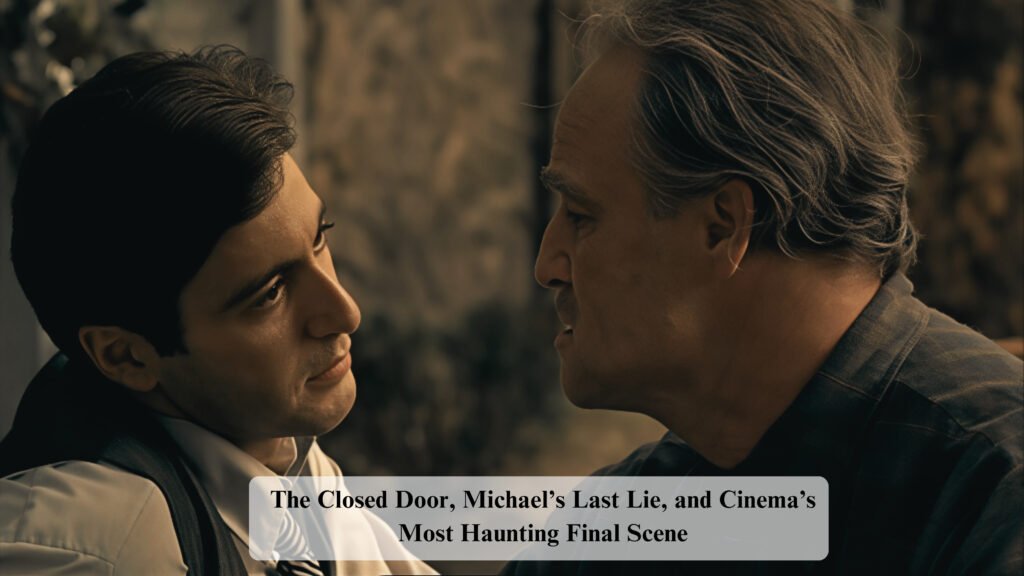
Inside his office, Michael now sits in his father’s chair, the unchallenged head of the Corleone family. In the hallway, Kay, still holding onto scraps of hope, asks him point-blank if he ordered Carlo’s death. His denial is calm, almost soothing. But as she watches a capo kneel, kiss Michael’s hand, and address him as Don Corleone, the truth bleeds through the lie. Her eyes tighten — she understands. Before she can react, the door swings shut between them.
That door is more than set dressing. It’s a barrier between two worlds — Michael’s shadowed realm of violence and Kay’s longing for honesty and love. It is also the final seal on Michael’s moral transformation: the man who once lived in daylight has chosen the dark, and that barrier is now permanent.
Before 1972, many crime dramas wrapped with tidy morality — the villain punished, the good rewarded. Coppola shattered that convention. He offered no reassurance, only the stark truth that sometimes the most dangerous man is the one who looks you in the eye and lies without blinking.
Michael Corleone’s Last Lie
The genius of Michael’s final lie is in its delivery. There’s no shouting, no defensive overcompensation — just a single, flat “No” in response to Kay’s question about Carlo. Al Pacino plays it with absolute stillness, the kind that makes the audience lean in.
We know the truth — we’ve just seen Michael orchestrate Carlo’s execution as part of a masterstroke that wipes out his enemies in one sweeping move. The denial isn’t just for Kay’s benefit; it’s also for Michael’s. By sealing the truth away, he’s telling himself that keeping her in the dark is a kind of protection. In reality, it’s the first act in the slow destruction of their marriage.
This lie is devastating because it’s intimate. It’s not the lie of a politician to the public or a mob boss to a rival. It’s the lie of a husband to a wife — the kind of lie that rewrites the foundation of trust, one brick at a time.
From Decorated Marine to Mafia Kingpin
Michael’s transformation is the spine of The Godfather Ending We meet him at Connie’s wedding in full military dress, a man set apart from the family’s business. He speaks of Luca Brasi and Johnny Fontane like distant relatives you might warn your children about. His mantra — “That’s my family, Kay, it’s not me” — is both a declaration and a shield.
But tragedies start chipping away at that shield. Sonny’s brutal murder. The attempt on Vito’s life. The need for someone — anyone — to act decisively to protect the family. That someone becomes Michael. The moment he guns down Sollozzo and McCluskey in the restaurant, he crosses an invisible line. He can never go back to the man Kay fell in love with.
By the time Godfather Ending reach the final scene, Michael is no longer playing the role of Don — he is the Don. His leadership style is colder, more surgical than Vito’s. Respect still exists, but fear is the true currency now. The closing of that office door is the ceremonial end of Michael Corleone, the son, and the coronation of Michael Corleone, the king.
Kay’s Shattering Realization
Kay has always been the audience’s tether to the “normal” world. She is our eyes, seeing the Corleones with a mix of fascination and caution. For much of the film, her love for Michael blinds her to the depth of his transformation.
In the final scene in Godfather Ending , that illusion dies. The moment she sees the gesture of loyalty — Clemenza’s kiss on Michael’s hand — she doesn’t need further explanation. The man she married is gone. Her look isn’t one of melodramatic heartbreak; it’s quieter, more devastating. It’s the moment someone realizes the future they envisioned is never coming.
Coppola resists the temptation to dramatize this with swelling strings or sharp dialogue. The silence is louder than any soundtrack. Kay is left in the bright hallway, physically and emotionally shut out. The audience feels the chill of that door closing as much as she does.
Layers of Symbolism Behind the Door
Godfather Ending That final door is a masterstroke of visual metaphor:
Division – A clear line is drawn between Michael’s private life and the brutal machinery of his business.
Deception – The door closes on the heels of a lie, sealing away the truth.
Isolation – Kay is outside, both literally and in terms of influence; Michael is now surrounded only by loyal soldiers.
Moral Descent – The light stays with Kay, the darkness with Michael — a deliberate inversion of their wedding-day dynamic.
Gordon Willis’s cinematography ensures that the frame speaks as loudly as the script. Shadows creep around Michael like a shroud, while Kay’s side is cleanly lit — the light of someone who has been kept apart from the blood on his hands.
How Coppola Made Restraint More Powerful Than Action
Ending The Godfather Ending with a quiet domestic moment instead of a flashy climax was a bold move. Coppola and cinematographer Gordon Willis built tension not through action, but through absence — no music, no score to guide the audience’s emotions. Just the cold mechanics of a man stepping fully into his destiny.
A lesser filmmaker might have chased the catharsis of confrontation — Kay shouting, Michael defending himself. But Coppola understood that the power lay in implication. By closing the door without further dialogue, he lets the audience’s imagination carry the weight of what comes next.
The Scene’s Enduring Influence
The final shot of The Godfather Ending has become part of the DNA of modern storytelling. Shows like The Sopranos and Breaking Bad owe a debt to its refusal to tie things up neatly. Tony Soprano’s own kitchen door moments are a direct homage to Michael Corleone’s.
Critics still argue about whether Michael’s descent was inevitable or a tragic accident of circumstance. That ambiguity keeps the film alive in cultural conversation. Each viewing raises new questions: Was Michael doomed from the start, or could he have walked away after the war? And perhaps more hauntingly — did he want to walk away at all?
A Door Closed, A Soul Locked Away
The genius of The Godfather ending is that it operates on two levels. On the surface, it’s the moment Michael consolidates his power. Beneath that, it’s the instant he sacrifices the last traces of his humanity.
We admire Michael’s brilliance, his strategic mind, his ability to survive in a world of wolves. Yet we can’t ignore the cost. When that door closes, it doesn’t just shut Kay out — it shuts us out. And from that point forward, Michael’s life is no longer a love story or a family drama. It is a reign.