 by
by I remember the first time I watched The Godfather. It was more than just a movie—it was a deep dive into a world where power, family, loyalty, and tragedy intertwined like vines. What struck me most was how the Corleone family legacy shaped each character’s fate, threading through each film like a constant heartbeat. It’s not just a crime saga. It’s a Shakespearean tragedy, set in 20th-century America, soaked in blood, duty, and silence.
The Birth of a Legacy: Don Vito Corleone
The story begins in Sicily, where a young boy witnesses the brutal murder of his father, brother, and mother. Forced to flee to America, Vito Andolini becomes Vito Corleone. From a scared immigrant to the most respected mafia don in New York, Don Vito builds the Corleone family legacy on a foundation of loyalty and strategic generosity. Unlike other dons who use brute force, Vito uses respect and favors as his weapons.
His motto is simple: “A man who doesn’t spend time with his family can never be a real man.” This line defines the core of the Corleone family legacy—family above all. We watch him give justice to the powerless, mediate peace, and yet orchestrate violence when necessary.
His presence is soft-spoken but powerful, and his decisions ripple through generations. Vito’s rise isn’t built on greed. It’s built on necessity, survival, and a relentless desire to protect his loved ones.
Vito’s early decisions show how cunning and strategic he is. When he eliminates the abusive local don, Don Fanucci, it’s not just revenge—it’s a calculated move to begin his empire. From there, he builds loyalty by helping others and never forgetting a favor. The Corleone family legacy is born not from bloodlust, but from intellect and empathy in a ruthless world.
Michael’s Reluctant Rise
Michael Corleone starts as an outsider—he’s the golden boy, the war hero who’s supposed to escape the criminal world. But fate pulls him back in. After an assassination attempt on his father, Michael kills a rival mob boss and a corrupt police captain, changing the course of his life forever.
Here, the Corleone family legacy starts to shift. Michael doesn’t just inherit power—he redefines it. He becomes more ruthless, more strategic, and more isolated. By the end of the first film, his transformation is complete. The door literally closes on his humanity as it opens into a darker legacy.
What began as a reluctant duty becomes an obsession. Michael tries to legitimize the family business, but he cannot escape the sins of the past. His decisions, though often necessary, carry a weight that eventually consumes him.
Michael’s cold nature contrasts deeply with his father’s warmth. While Vito valued peace, Michael values control. The Corleone family legacy under Michael becomes militarized—every move is war. And in war, there are no innocent casualties.
Power and Paranoia in Part II
The Godfather Part II is arguably one of the greatest sequels in film history. It does something few sequels dare—it juxtaposes two timelines. We see Vito’s rise in the past and Michael’s descent in the present.
As Michael expands the empire, the Corleone family legacy becomes soaked in paranoia. He loses his wife Kay, becomes estranged from his children, and even orders the execution of his own brother Fredo. It’s chilling, but it’s inevitable. Power isolates him, and his vision of preserving the legacy ironically destroys what it once stood for.
In contrast, young Vito (played brilliantly by Robert De Niro) navigates the streets of New York with humility and wisdom. His legacy is built from the ground up, rooted in survival and respect.
Michael’s actions in Part II are devastating. He pushes away everyone close to him. He doesn’t trust anyone, not even Tom Hagen, his adopted brother and consigliere. And that distrust becomes his undoing. The Corleone family legacy turns into a hollow empire—one that’s feared, but no longer respected.
The Final Tragedy in Part III
By the time we reach The Godfather Part III, Michael is older, remorseful, and haunted. He tries to buy redemption through charity and legitimacy, but fate doesn’t forget. His daughter Mary is tragically killed, and Michael dies alone, broken and forgotten.
The Corleone family legacy ends not with triumph, but with a sobering reflection on the cost of power. What started with the noble intent of protecting family ends in death and isolation.
Michael’s confession to the priest is heartbreaking. He breaks down, weeping over his sins, yet he knows redemption will never come. His attempts to escape the past are futile. The sins of the father—and the son—are carved into the family name.
Character Deep Dives
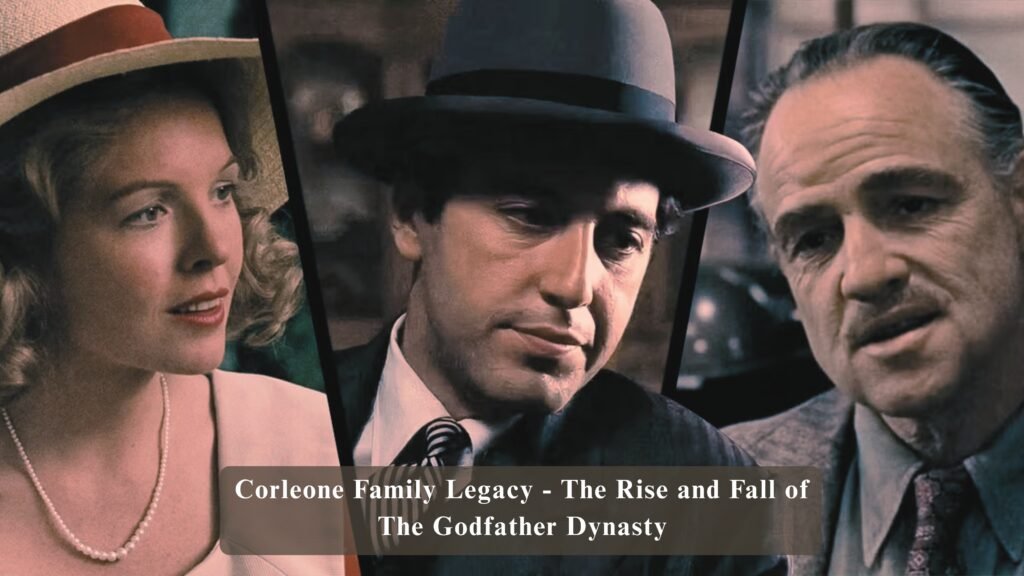
Tom Hagen: The Loyal Outsider
Tom is not Italian, but he’s treated like a son. As the family’s consigliere, he embodies calm, logic, and diplomacy. Yet, he’s often sidelined in favor of blood. This is one of the many contradictions in the Corleone family legacy. Loyalty is valued—but only when it’s tied to blood.
Sonny Corleone: The Hotheaded Heir
Sonny was never meant to be Don. He’s impulsive, violent, and emotional. Yet his loyalty to family is unquestionable. His brutal death is one of the most iconic moments in the trilogy and represents the volatility of the family’s position.
Fredo Corleone: The Tragic Brother
Fredo’s betrayal is not born out of hatred—it’s born from insecurity. He wants to be respected. Michael’s decision to have him killed is necessary for business, but a permanent scar on the Corleone family legacy.
Kay Adams: The Innocent Witness
Kay, Michael’s wife, represents the American dream. She’s shocked to discover that the man she loves is capable of unimaginable cruelty. Her slow disillusionment mirrors the audience’s. She starts as a hopeful outsider and ends as a broken mother, denied access to her children.
Key Scenes Breakdown
The Opening Scene (Wedding): The perfect setup. While the wedding is joyous, the dark world of the family business operates in the shadows. This contrast defines the Corleone family legacy.
Michael’s First Kill: The restaurant scene is legendary. The silence, the tension, the sudden explosion of violence—it’s Michael’s point of no return.
The Baptism Scene: As Michael renounces Satan, his men murder the heads of rival families. This powerful juxtaposition shows the duality of power and faith in the Corleone family legacy.
Fredo’s Death: Michael’s cold stare as Fredo is taken fishing is the most devastating moment in Part II. It’s not just about betrayal—it’s about the cost of leadership.
Mary’s Death: In Part III, her death is the final nail in the coffin. Michael’s silent scream is the culmination of years of guilt and consequence.
Themes that Define the Corleone Family Legacy
Power vs. Family
The central theme is the struggle between power and family. Vito found a balance. Michael couldn’t. The Corleone family legacy suffers as a result.
Loyalty and Betrayal
Loyalty defines the family’s strength—but betrayal defines its downfall. Every betrayal (Fredo, Tessio, Carlo) leads to deeper paranoia.
Redemption and Guilt
Michael seeks redemption, but it’s always just out of reach. The weight of guilt defines his final years.
The Illusion of Control
Michael believes he can control everything. But fate, family, and emotions cannot be controlled forever.
Cinematic and Cultural Impact
The Godfather trilogy changed cinema forever. Its storytelling, cinematography, music, and performances became a blueprint for modern film. The Corleone family legacy became a cultural reference—quoted, studied, and admired.
Francis Ford Coppola’s direction is masterful. Every frame tells a story. The use of lighting, especially shadows and warm tones, reflects the moral ambiguity of the characters.
The soundtrack, composed by Nino Rota, is haunting. The theme captures the elegance and tragedy of the family.
A Legacy Beyond Blood
The Corleone family legacy doesn’t end with Michael. It continues in discussions, in film schools, in the way we understand character arcs and storytelling. It’s not just a fictional dynasty—it’s a lens into the human soul.
Every decision Vito and Michael make echoes into the next scene, the next film, the next generation. Watching the trilogy is like watching a legacy being written in real time—glorious, painful, unforgettable.
Whether it’s the whisper of Don Vito or the silent scream of Michael, the Corleone family legacy speaks volumes about ambition, love, loyalty, and loss.
Final Reflection
What makes The Godfather timeless is not the violence or the power games. It’s the humanity. The quiet moments between chaos. The tragedy behind every decision. And most of all, the weight of legacy.
The Corleone family legacy is a mirror—sometimes it reflects what we admire, other times what we fear. But in every reflection, there’s truth.
And that’s why, decades later, I keep coming back to it.
Want to dive deeper into cinema? Check out more of my movie blogs here…