 by
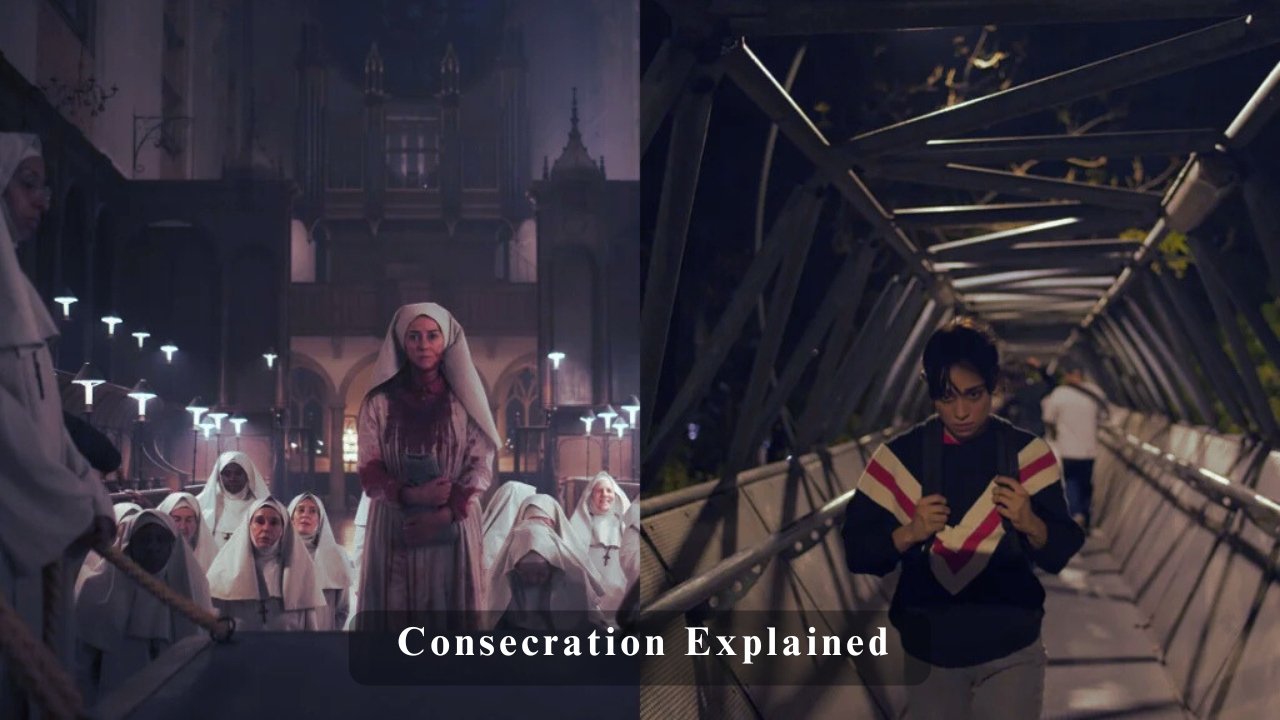
by As a 25-year-old movie blogger, I’ve watched many horror films that deal with exorcisms, haunted convents, and psychological breakdowns. But Consecration (2025) takes a different route. Its horror lies in the unraveling of Grace’s mind—and the source of that unraveling lies in her past. That’s what makes Consecration Explained not just a breakdown of events, but a deep dive into trauma, faith, and fractured identity.
The movie doesn’t hand you answers. It asks you to piece together the puzzle through Grace’s fragmented flashbacks. And those fragments are more horrifying than any ghost.
Act 1: The Seeds of Trauma
Consecration Explained begins with Grace arriving at a convent in Scotland after the mysterious death of her brother, a priest. But before we can even grasp the present, the past begins to bleed through. Her first flashback shows her as a little girl, curled up in bed, listening to her parents scream at each other.
Her father, an atheist, and her mother, a religious zealot, created a household built on conflict. One parent gaslit her mind, while the other demanded unquestioning faith. This dichotomy planted the first seed of mental conflict within her.
The abuse isn’t overt at first. But the camera lingers just a bit too long on Grace’s fearful eyes and trembling hands. It’s clear she’s absorbing all of this. Trauma has begun its quiet invasion.
Spiritual Abuse and Religious Indoctrination
Another key flashback that stands out in Consecration Explained shows Grace being dragged to a small candle-lit room by her mother. Her knees are bruised from hours of forced prayer. Her questions are labeled as blasphemy. And worst of all, her visions are encouraged—not for healing, but as proof of divine purpose.
This is one of the film’s darkest commentaries: when religious belief becomes abuse. We see young Grace crying in silence, holding a rosary like it’s both a weapon and a shield. The line between God and punishment blurs. She’s taught that suffering is sacred. That her pain is a blessing.
Consecration Explained doesn’t villainize religion entirely. Instead, it presents a terrifying reality: belief, when twisted, can become a prison.
A Sister’s Insight: Sister Beth Knows More
Sister Beth warns Grace early in the film: “You’ve always belonged to her.”
Who is “she”? Is it the Virgin Mary? A demon? Grace’s own mother reincarnated in memory? That one cryptic line becomes a thread that weaves through all the flashbacks.
Sister Beth seems to understand that what Grace is facing isn’t purely supernatural—it’s deeply psychological. Beth’s warning becomes a voice of reason, hinting that Grace’s past is more dangerous than the haunted convent.
Grace’s Visions: Madness or Calling?
In a pivotal flashback, young Grace sees a radiant woman in white—a figure her mother later claims is the Virgin Mary. Grace believes it. It comforts her. But the light begins to flicker, and the woman’s face slowly becomes disfigured.
This is Consecration Explained at its most effective. It shows us the duality of belief: what starts as divine quickly becomes grotesque. The angel becomes a demon. Grace’s visions, once a source of comfort, morph into weapons of mental destruction.
Later in the film, Grace tells a priest, “I’ve seen her since I was a child. She comes to me when I sin.”
This quote perfectly encapsulates her internal battle. Her divine visions aren’t gifts. They’re punishments, rooted in guilt.
The Tragedy of Her Father’s Death
A devastating flashback reveals Grace standing at the top of the stairs. Her father is shouting. There’s a sudden silence. Then he falls.
Did Grace push him? Did he fall in despair? The film never tells us. And that’s the genius of Consecration Explained. It forces us into Grace’s fractured memory, where truth is unreliable.
Whether she caused his death or not, the guilt follows her like a shadow. She remembers his screams. The blood. And the eerie stillness afterward.
Repeating Patterns: The Convent Mirrors Her Past
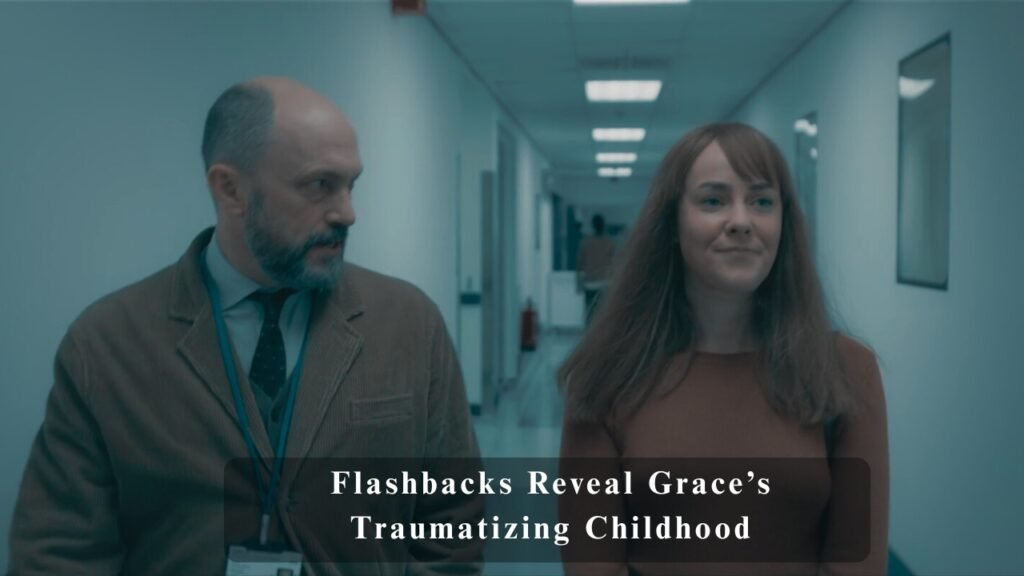
The convent is not just a setting—it’s a reflection of her childhood. Silent corridors. Ritualistic prayers. Authority figures demanding blind obedience.
In one haunting flashback, Grace is locked in a room for “purification.” Decades later, she finds herself in the convent’s punishment cell, and the two timelines overlap visually. She is a child and an adult at once, trapped in an endless cycle.
Consecration Explained uses this mirroring technique to show how trauma repeats itself. How the environments of our past creep into the present.
Divine Bloodline or Delusion?
The climax delivers a heavy revelation: Grace’s mother believed she was descended from saints. That she was chosen. And that Grace would be the final sacrifice to fulfill some divine legacy.
Was this delusion or truth? That’s left unanswered. But what matters is how it shaped Grace’s identity. She was never just a daughter. She was a vessel. A prophecy.
Her entire childhood was preparation for martyrdom. Her pain was ritualized. Her trauma was spiritualized.
The Real Horror: A Mind Torn by Faith and Fear
In the end, we see Grace alone in a chapel. She looks at a stained glass window of the Virgin Mary. It morphs into the woman in white. Then back again. Then darkness.
She whispers, “I forgive you.”
Who is she speaking to? Her mother? Herself? God?
That ambiguity is the final stroke in Consecration Explained. It refuses easy answers. Because trauma doesn’t resolve neatly. It lingers. It haunts.
Final Thoughts
As a young horror fan, what struck me most about Consecration was not the ghosts, but the ghost of childhood trauma. The real exorcism here isn’t of demons, but of memories. Consecration Explained is less about who killed whom and more about what was lost in the process—innocence, identity, and clarity.
Grace’s story is a tragic reminder that sometimes the scariest thing isn’t the monster under the bed. It’s the belief system that raised you.
This film doesn’t just show horror. It understands it. And that’s what makes it unforgettable.
If you found this breakdown insightful, follow for more deep-dive psychological horror content. And let me know in the comments—do you think Grace was divine… or disturbed?