 by
by Introduction
As a 25-year-old horror movie enthusiast, I found Consecration (2025) to be one of the most thought-provoking psychological thrillers in recent years. With its haunting visuals, religious overtones, and mysterious narrative, the film leaves viewers with more questions than answers. That’s why in this post, titled Consecration Ending Explained, I’ll take you through a full breakdown of the story, the hidden symbols, and the chilling truth about Grace’s fate. If you’re searching for clarity after watching this complex movie, you’re in the right place.
What is Consecration (2025) About?
Before diving into the Consecration Ending Explained, it’s important to understand the foundation of the story. Directed by Christopher Smith, Consecration is a religious psychological horror film that centers on Grace, a woman whose brother—a priest—dies mysteriously at a remote Scottish convent. The Church claims it was suicide. Grace believes otherwise.
The narrative unfolds with a blend of psychological unease, religious mysticism, and occult symbolism. As Grace delves deeper into the truth, she begins to experience supernatural visions and uncovers dark secrets buried within the convent walls. But what makes Consecration unique is its open-ended conclusion, which blurs the line between divine intervention and mental unraveling.
Full Story Recap
To truly understand the Consecration Ending Explained, let’s walk through the key events of the movie in detail.
Grace’s Arrival at Mount Savior Convent
in Consecration Ending Explained Grace is introduced as an independent and rational woman who does not practice religion. She travels to Mount Savior Convent in Scotland to recover her brother Michael’s body after he supposedly committed suicide by jumping out of a window. Her arrival is met with suspicion and hostility by the nuns, especially Mother Superior, who is cold and secretive.
Grace becomes increasingly disturbed by the convent’s atmosphere. The location itself is remote and oppressive, with an eerie silence and strange rituals being practiced behind closed doors. Grace begins to feel that her brother’s death was not a suicide, but a murder tied to something deeper.
Michael’s Journal and the First Visions
Grace discovers her brother’s hidden journal in his quarters. In it, Michael writes about feeling watched and manipulated by the sisters of the convent. He also hints at prophetic dreams and voices that instructed him to protect Grace.
After reading the journal, Grace starts experiencing visions—bleeding eyes, a faceless child, and a shadowy figure dressed in white. These visions escalate in intensity, leading her to question her own sanity. But the more Grace investigates, the clearer it becomes that these visions may not be hallucinations but supernatural revelations.
Uncovering the Rituals
Grace follows a trail of clues that leads her to underground chambers beneath the convent. There, she uncovers evidence of ancient religious rituals performed by the nuns over centuries. Symbols carved into the walls suggest a belief in purification through blood and divine suffering. She also learns that the convent was built on the site of violent martyrdoms from early Christian history.
In a chilling moment, Grace witnesses a reenactment of a ritual in which a young woman is blindfolded and bled. It becomes clear that these acts are not symbolic but literal, and Michael had tried to expose them.
The Vatican’s Involvement
Father Romero, a priest sent by the Vatican, arrives to observe Grace’s behavior. Initially, he appears to be supportive. However, his intentions are revealed to be aligned with the Church’s interest in suppressing the truth. He is not there to help Grace but to contain the situation.
Romero tries to convince Grace that her visions are delusions rooted in childhood trauma. He insists that Michael was mentally unstable and that Grace is on the same path. But Grace doesn’t buy it.
Childhood Trauma and Flashbacks
Throughout the film, Grace experiences recurring flashbacks of her childhood. These include images of her mother being institutionalized and her father performing strange prayers over her as a child. One memory reveals a particularly disturbing event: a young girl being killed in what appears to be a religious rite.
These flashbacks intensify Grace’s sense of confusion. Is she a victim of trauma, or is she remembering a prophecy? Slowly, Grace begins to suspect that her entire identity has been shaped by forces she never understood.
The Final Revelation
The final act of the film brings Grace face-to-face with the truth. She learns that she was born into a cult that believed she was a divine vessel—the Redeemer. Her mother fled the group when she realized what was happening, but Grace was already marked by the prophecy.
Michael, knowing the truth, became a priest to protect Grace. When the convent learned of her arrival, they orchestrated a ritual meant to awaken her divine essence. Michael refused to go along with the plan and was killed to keep him silent.
As Grace begins to accept her role, her powers emerge. In the climax, she unleashes a supernatural force that kills several of the nuns, including Mother Superior. Father Romero attempts to flee, only to be confronted by Grace in her final, terrifying form.
Consecration Ending Explained: What Really Happened?
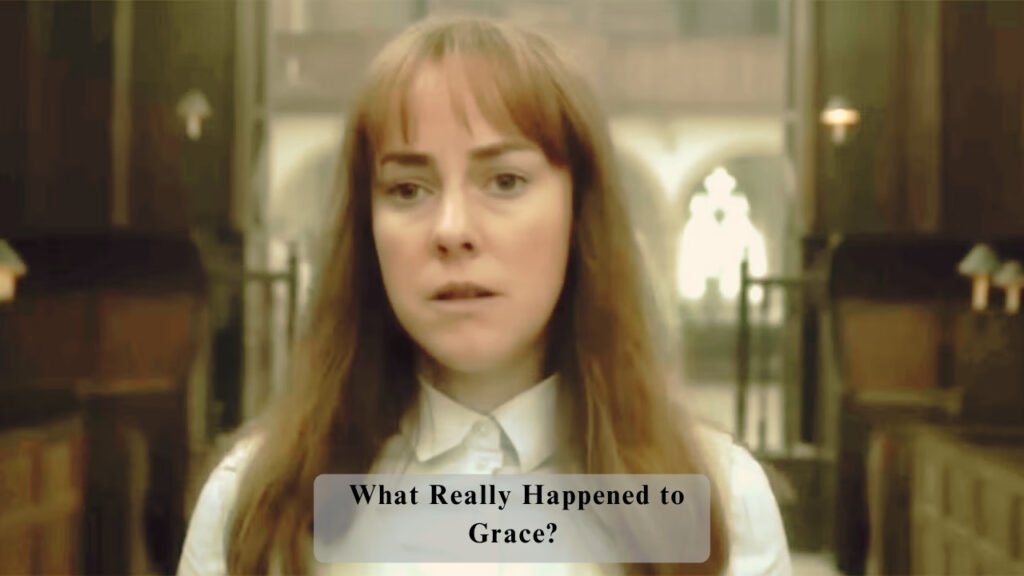
Now, let’s decode the layered and ambiguous conclusion of Consecration Ending Explained.
Is Grace Possessed or Enlightened?
Consecration Ending Explained The most haunting question of the film is whether Grace becomes possessed or truly awakens to her divine identity. The answer lies in the religious symbolism throughout the film. Grace is not possessed in the traditional sense. Rather, she fulfills the prophecy of the Redeemer—a being who bridges the human and divine through pain and truth.
Her visions were not signs of madness, but glimpses of spiritual knowledge. The convent did not fear her insanity; they feared her power.
Michael’s Death: Suicide or Murder?
Michael’s death is a central mystery. While the Church claims it was suicide, the final visions reveal he was pushed during a failed ritual. His final act was one of resistance—trying to protect his sister. His spirit lingers to guide Grace, appearing multiple times to steer her away from danger.
This supports the idea that Consecration is a story of spiritual inheritance and sacrifice, rather than mere horror.
The Role of the Church
The Church is portrayed as a corrupt institution seeking to control divine truth. Rather than embracing Grace’s awakening, they attempt to silence her. The Vatican’s involvement, especially through Father Romero, represents organized religion’s fear of uncontrolled spirituality.
The convent’s rituals were not meant to serve God, but to contain prophecy. This theme echoes through horror cinema, but Consecration Ending Explained gives it a more personal, psychological edge.
Grace’s Final Transformation
In the final scenes, Grace emerges from the convent, covered in blood but spiritually awakened. Her face is calm, but her eyes glow with newfound power. She has become something new—not fully human, but not monstrous either.
The film ends with Grace walking alone, leaving viewers uncertain whether she will bring salvation or destruction.
This ambiguity is the heart of the Consecration Ending Explained—a story of identity, belief, and the thin line between divine enlightenment and psychological collapse.
Hidden Symbolism and Themes
To understand the film’s deeper meanings, let’s explore some of the hidden symbols and thematic elements.
Blood as Purification
Blood rituals in the film symbolize purification and sacrifice. This ties directly to early Christian martyrdom, where suffering was seen as a path to sainthood. The nuns’ obsession with blood reflects their belief in pain as spiritual currency.
The Eye Motif
Eyes bleeding, blindfolded girls, and visions all point to the theme of seeing versus believing. Grace gains sight through suffering, but others remain blind to the truth.
The Mirror
The mirror Grace stares into during key scenes represents self-realization. It shows not her physical image, but her spiritual essence. Each reflection reveals a different truth, mirroring her fractured identity.
Final Thoughts: Why Consecration Leaves a Lasting Impact
Consecration Ending Explained is not a straightforward horror film. It combines psychological tension, religious dread, and mysticism into a deeply unsettling experience. The open-ended finale forces viewers to ask difficult questions: What is faith? What is madness? And what if they are the same?
Through this Consecration Ending Explained, we can see that Grace’s journey is less about solving a murder and more about discovering who she truly is. Whether she is a savior, a victim, or something in between is left to interpretation—but the impact of her story lingers long after the credits roll.
Conclusion
This post titled Consecration Ending Explained aimed to break down every important moment of the film and decode its symbolism, themes, and meaning. As someone deeply invested in the psychological horror genre, I found Consecration to be a haunting exploration of the human psyche under religious pressure.
If you enjoyed this breakdown, stay tuned for more in-depth film analyses. And if you haven’t seen Consecration (2025) yet, consider watching it again after reading this—every scene holds more meaning than you think.