
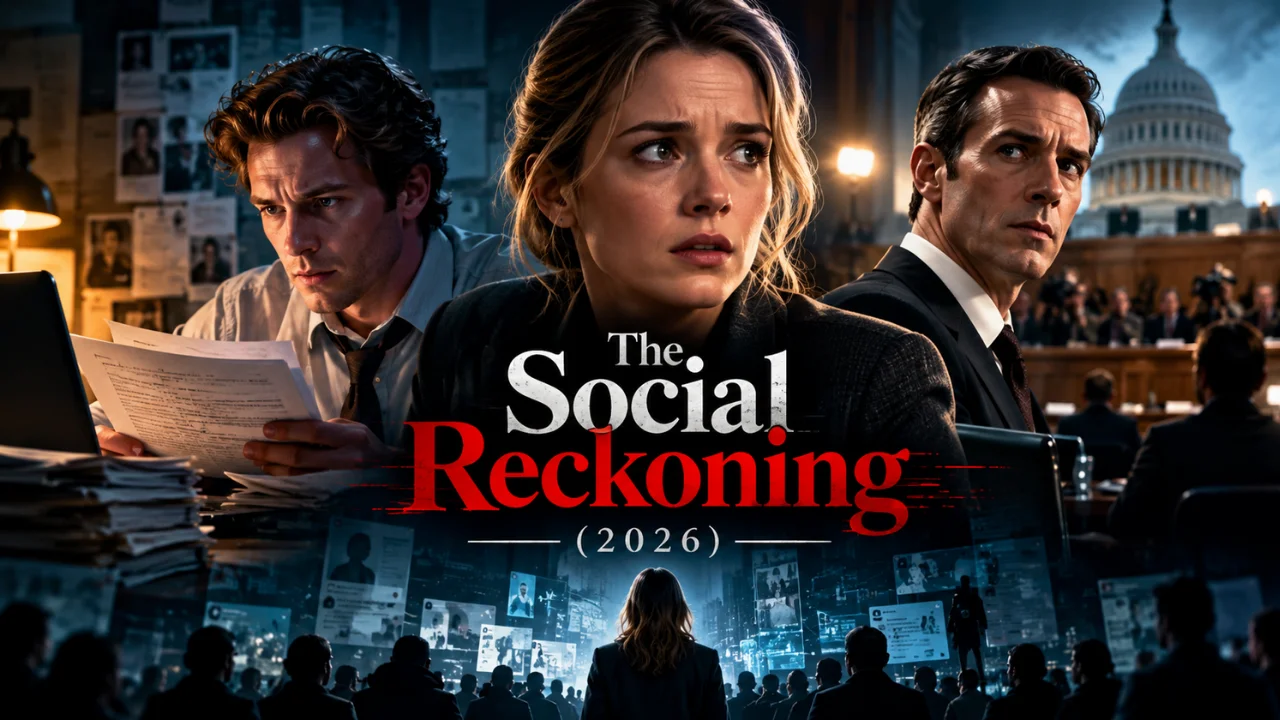
The Social Reckoning (2026): Cast, Story, Release Date and Connection to The Social Network
The Social Reckoning (2026) is Aaron Sorkin’s drama about Facebook whistleblower Frances Haugen, journalist Jeff Horwitz and the questions surrounding one of the world’s most influential social media platforms. Opening in US cinemas on October 9, 2026, the film revisits the story of Facebook at a later stage, focusing on the scrutiny the company faced over its decisions and influence.
The main roles bring together Mikey Madison as whistleblower Frances Haugen, Jeremy Allen White as journalist Jeff Horwitz, and Jeremy Strong as Facebook chief Mark Zuckerberg. Inspired by the events surrounding the 2021 Facebook Files investigation, it explores the relationship between internal company information, investigative journalism and corporate accountability.
Sony Pictures positions the movie alongside The Social Network, but the newer story examines a different chapter in Facebook’s history rather than revisiting its founding. It examines a different period in Facebook’s history, when questions about the platform’s decisions and wider effects became central to public debate.
Here is everything to know about The Social Reckoning, including its cast, story, real-world background, release date and connection to the 2010 film.
What Is The Social Reckoning About?
Written and directed by Aaron Sorkin, The Social Reckoning centres on Frances Haugen, a former Facebook employee who became a prominent whistleblower in 2021. Her disclosures became part of a wider investigation in which Wall Street Journal journalist Jeff Horwitz examined internal Facebook material and reported on its significance.
The story draws on the events associated with the Facebook Files, a series of investigative reports based on internal documents that raised questions about Facebook’s approach to content moderation, platform safety and the wider effects of its services.
Haugen’s disclosures helped journalists examine what the company’s internal research and discussions revealed about its products. The resulting reporting brought greater attention to the difficult relationship between a technology platform’s business decisions and its potential effects on users and society.
The investigation drives the story forward: Haugen brings concerns about Facebook’s internal practices, and Horwitz’s reporting examines the documents and explains what they may reveal about the company. Their work raises a fundamental question: what should happen when information held inside a powerful company becomes a matter of public concern?
Although real events inspired the film, it remains a fictionalised screen production. Some conversations and sequences may have been adapted for dramatic effect, so viewers should consult contemporary reporting when checking specific historical details.
For the underlying context, readers can consult The Wall Street Journal’s Facebook Files coverage and Reuters’ interview with Aaron Sorkin. Reading these reports alongside the film helps readers distinguish publicly documented events from scenes shaped for dramatic storytelling.

The Social Reckoning Cast
The film features a new central cast, with actors portraying people connected to Facebook and the reporting around the Facebook Files.
For the film’s listed cast, director and release details, see The Social Reckoning on IMDb.
Mikey Madison as Frances Haugen
Mikey Madison plays Frances Haugen, the former Facebook employee whose disclosures brought renewed public attention to the company’s internal practices.
Haugen’s role in the real-world events gives the story its human starting point. Rather than focusing exclusively on executives and corporate decisions, the narrative follows someone who had access to internal information and faced the difficult decision of bringing it outside the organisation.
The role also places the film within the broader tradition of whistleblower dramas, where an individual’s access to information creates a conflict between professional obligations, personal risk and public interest.
Jeremy Allen White as Jeff Horwitz
In the film, Jeremy Allen White plays Jeff Horwitz, whose reporting forms an important part of the Facebook Files storyline.
Horwitz’s part in the story focuses on what happens after internal records become available. The documents need to be assessed, checked against relevant evidence and explained in a way that helps readers understand their significance.
Haugen’s connection to Facebook gives her access to internal information, whereas Horwitz’s role centres on examining that material through journalism. Together, their work illustrates how information from within an organisation can lead to public scrutiny.
Jeremy Strong as Mark Zuckerberg
In this film, Jeremy Strong portrays Mark Zuckerberg, the Facebook co-founder who was played by Jesse Eisenberg in the 2010 drama The Social Network.
The new film approaches Zuckerberg from a later period in the company’s history. Instead of concentrating on the ambition and disputes surrounding Facebook’s founding, it examines questions about leadership, influence and responsibility.
With Jeremy Strong taking over the role, the new film presents Zuckerberg through a different performance and a later period of Facebook’s development.
Supporting Cast
-
Wunmi Mosaku
-
Betty Gilpin
-
Billy Magnussen
-
Bill Burr
The principal story, however, centres on Haugen’s disclosures, Horwitz’s investigation and Zuckerberg’s position at Facebook.
For the confirmed cast and production information, visit the official Sony Pictures film website.
How Does The Social Reckoning Connect to The Social Network?
The Social Network tells the story of Facebook’s early years, while The Social Reckoning examines a later chapter involving scrutiny of the company. Sony describes the newer film as a companion piece, although Sorkin has said he does not regard it as a standard sequel.
This difference in focus explains why the newer film can stand on its own while remaining connected to the earlier story.
The Social Network dramatised Facebook’s beginnings, the ambition surrounding its creation and the disputes that accompanied its early growth. Its central question was closely tied to how the company came into existence and the personal relationships affected by that process.
The Social Reckoning moves forward in time. It focuses on a company that has already become a major force in digital communication and examines the scrutiny that followed its expansion.
The two films therefore share a world and a central figure but approach that world from different directions. One looks at the making of a technology company; the other examines what happens when that company’s decisions attract sustained public attention.
Sorkin has also described the new film’s unusual narrative structure. According to TheWrap’s interview with Sorkin, the story uses two timelines: one follows the investigation into Facebook’s practices, while the other shows Zuckerberg preparing for a congressional hearing.
The parallel timelines connect the reporting process with the preparations for a congressional hearing. This structure lets the audience follow the development of the investigation while also seeing how the company is brought into the public debate.
Why Did Jesse Eisenberg Decline to Return as Zuckerberg?
Jesse Eisenberg does not reprise his role as Zuckerberg in The Social Reckoning. Jeremy Strong takes over the part.
In its coverage of the casting decision, TheWrap reported that Eisenberg declined to reprise the role after Sorkin approached him about returning. The report attributed the decision to Eisenberg’s wish not to remain closely associated with Zuckerberg.
The casting change also makes sense in the context of the new film’s different time period and dramatic focus. The story does not simply recreate the circumstances of Facebook’s founding. It examines a later chapter in the company’s history, with different questions about power, influence and responsibility.
Strong’s performance should therefore be viewed as a new interpretation of Zuckerberg, not merely an attempt to reproduce Eisenberg’s portrayal. The two films approach the character at different stages of Facebook’s development and have different narrative priorities.
Which Real Events Inspired The Social Reckoning?
The film draws on the events surrounding Frances Haugen’s 2021 disclosures and the investigative reporting known as the Facebook Files. Its presentation is designed for cinema, so the finished story should be distinguished from the original documents and contemporaneous news reports.
A feature film cannot include every detail of a complex investigation. Events may be condensed, conversations recreated and timelines adjusted to keep the narrative moving. For that reason, viewers should use independent reporting to verify specific details instead of assuming every scene happened exactly as shown.
The Facebook Files investigation brought previously internal company information into wider public debate. Its findings encouraged closer examination of Facebook’s decisions and sparked discussion about how social platforms identify potential harms and communicate their policies to users.
Readers who want to examine the events in greater depth can consult the original Facebook Files reporting and other reliable coverage. These sources provide evidence and context that a dramatised film alone cannot supply.
What Makes The Social Reckoning Different From Other Technology Dramas?
One of the film’s defining features is its focus on the relationship between a whistleblower and an investigative journalist. Many technology stories centre on founders, investors or competition between companies. This story instead asks what happens when people inside an organisation challenge decisions made by the organisation itself.
Haugen’s access to Facebook’s internal material and Horwitz’s work as a reporter serve separate purposes. Her disclosures provide a starting point; his investigation examines the information and explains its relevance beyond the company itself.
The film’s connection to a congressional hearing adds another dimension. Public scrutiny does not end when documents are released or a story is published. Questions may continue through political debate, regulation and public discussion. A hearing can create a moment of confrontation, but it does not automatically resolve the underlying issues.
This is also where the film’s two-timeline structure becomes relevant. By following an investigation alongside preparations for a hearing, the story can connect the work of uncovering information with the challenge of responding to it.
These elements distinguish the premise from a straightforward biography of a technology executive. The emphasis is on the system surrounding the individual: internal decisions, reporting, public scrutiny and the consequences of a platform’s influence.
Why Is The Social Reckoning Relevant Today?
The film raises questions that extend beyond Facebook. It invites viewers to consider how social media platforms should handle harmful content, what transparency users can reasonably expect and how companies should respond when internal evidence raises concerns.
One important issue is the relationship between business incentives and public responsibility. Technology platforms need sustainable businesses, but their products can also shape how people encounter information and interact with one another. When those interests appear to conflict, it becomes important to understand what a company knew, what choices it made and how those decisions were evaluated.
Another issue is the role of whistleblowers. People inside an organisation may have access to information that outsiders cannot easily obtain. Bringing that information to light can raise difficult questions about confidentiality, professional obligations and the public interest. The story also raises questions about how disclosures should be assessed: evidence needs scrutiny, and a company’s response should be examined rather than accepted without question.
Investigative journalism is equally important. Documents do not explain themselves. Reporters must verify information, examine context and communicate why it matters. The relationship between Haugen’s disclosures and Horwitz’s reporting helps illustrate that process.
The movie covers only one part of a much wider debate about social media. Readers who want the full context should also consult independent investigations and public records rather than relying on the film alone.
The Social Reckoning Release Date
The Social Reckoning opened in US theatres on October 9, 2026, according to the official film website.
Release dates and availability can differ by country. Viewers in India and other regions should check local cinema listings and official distributor announcements for confirmed regional dates.
A theatrical release does not automatically confirm when a film will become available on a streaming service. Streaming dates, platforms and subscription requirements should be checked through official announcements rather than unverified reports.
For the most reliable production and release information, start with the official The Social Reckoning website.
Final Verdict: What Should Viewers Expect?
Rather than revisiting Facebook’s beginnings, The Social Reckoning focuses on the scrutiny that followed the platform’s growth and the people who brought its internal practices into public discussion.
Its cast, real-world inspiration and investigative storyline make it relevant to viewers interested in technology, journalism and corporate accountability. The connection to the earlier film adds context, but the new story has its own focus and concerns.
The most useful way to approach the film is as a dramatisation of documented events, not a replacement for the original reporting. Its narrative can bring complex issues to a wider audience, while independent journalism helps readers distinguish established facts from creative interpretation.
For viewers who want to understand the Facebook Files, the film provides an entry point. Reading the underlying reporting alongside it offers a fuller picture of the events and the questions that remain open.
Looking for more film updates? Explore our movie coverage and reviews for additional cast guides, release-date updates and movie explainers.
Frequently Asked Questions
1. What is The Social Reckoning about?
The film follows Frances Haugen and journalist Jeff Horwitz in a story inspired by the Facebook Files investigation and questions surrounding Facebook’s internal practices.
2. Who plays Frances Haugen in the 2026 film?
Mikey Madison portrays Frances Haugen in The Social Reckoning.
3. Who plays Mark Zuckerberg in the film?
Jeremy Strong plays Mark Zuckerberg. Jesse Eisenberg, who portrayed Zuckerberg in The Social Network, does not return.
4. Is The Social Reckoning a sequel to The Social Network?
The films are connected, but Sony describes The Social Reckoning as a companion piece. Sorkin has said he does not think of it as a conventional sequel.
5. Why is Jesse Eisenberg not in The Social Reckoning?
TheWrap reported that Sorkin said Eisenberg did not want to be conflated with Zuckerberg anymore. Jeremy Strong plays Zuckerberg in the new film.
6. Is The Social Reckoning based on real events?
Yes. It is inspired by Frances Haugen’s disclosures and the Facebook Files reporting, although the story is dramatised for a feature film.
7. When was The Social Reckoning released?
Sony lists October 9, 2026, as the US cinema release date. Audiences elsewhere should consult local cinema schedules or official distributor updates for their region.
8. Where can I watch The Social Reckoning?
To find current viewing options, check cinema listings in your area and announcements from the film’s official distributor or licensed streaming platforms.
9. Who directed The Social Reckoning?
Aaron Sorkin wrote and directed the film.
10. What is the Facebook Files investigation?
The Facebook Files refers to investigative reporting based on internal company documents that examined Facebook’s practices and raised questions about the platform’s wider effects.